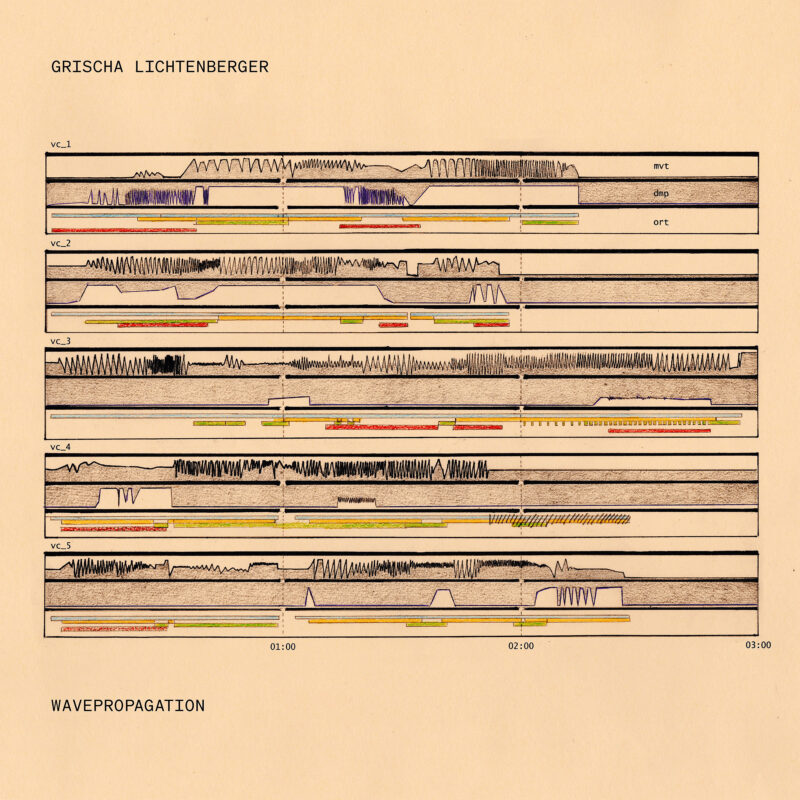
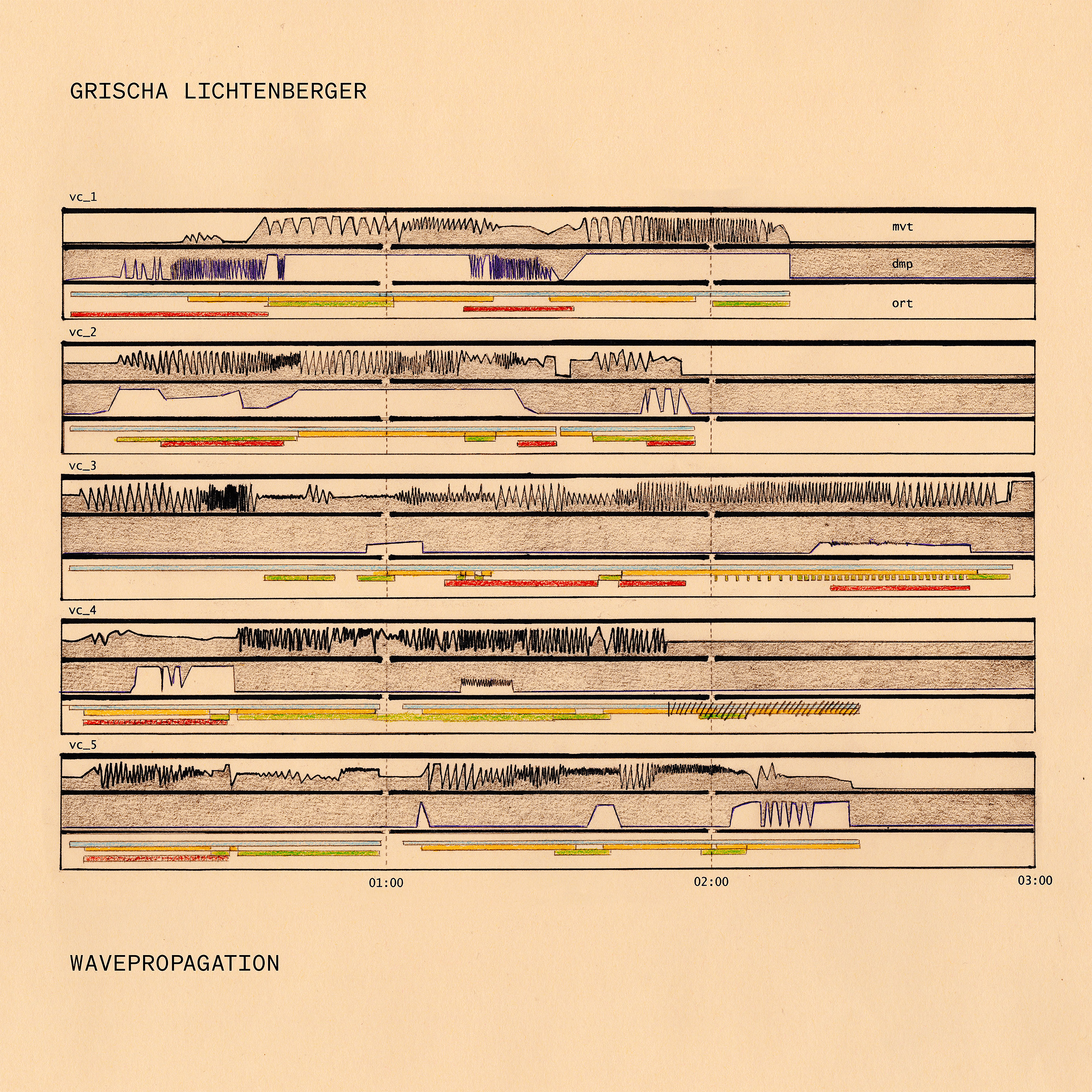
wavepropagation originates from a simple constraint: to construct entire pieces through the manipulation of a single functional oscillator, generating melody, bass and percussion from one voice.
By transforming its waveform, introducing transients, harmonic shifts and low-frequency pitch envelopes, a single oscillator can produce the impression of multiple, independent sound sources. Moving between elementary sine waves, triangular shapes and more chaotic, noise-like forms, wavepropagation explores how complexity can emerge from a single continuous signal.
At the core of the record is a fascination with the amount of information a wave can contain. A loudspeaker performs one basic movement — pushing and pulling air — yet through this movement it can reproduce the complexity of an entire orchestra.
The idea is reflected in an experience on Kyiv’s Darnytskyi Bridge, where Lichtenberger observed the surface of the Dnipro: swimmers, boats and activity along its banks leaving overlapping traces in the water. The image recalled Richard Feynman’s observation that the seemingly chaotic waves of a swimming pool contain information about everything that has disturbed its surface.
wavepropagation applies this principle to sound: multiple events can coexist within a single moving form.
The title also refers to the way waves continue through moments of apparent cancellation. Two waves may meet and momentarily produce zero, yet neither disappears; both continue to propagate beyond that point.
At one moment: zero. At the next: something again.
The cancellation is local. The propagation is not.